No. 021 Thursday · May 28, 2026 ≈ 5 min read

Private connectors enter the builder flow.

The day’s strongest signal is not a single design tool launch. It is MCP becoming the connective layer between private systems, creative generators, production dashboards, and the agents designers already use.

Private tunnels Creative MCP Inline tools
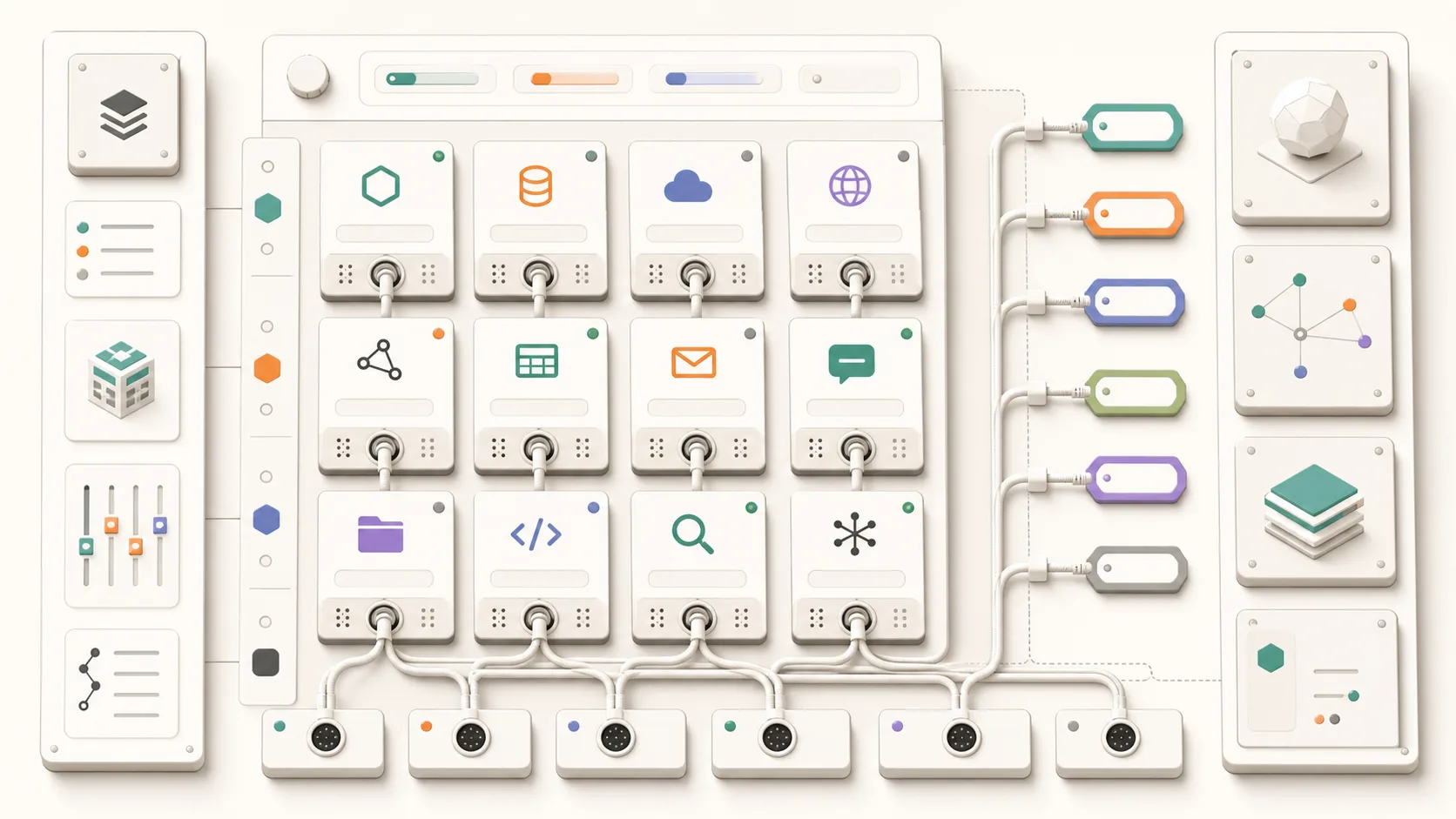
Abstract connector catalog with endpoint panels, socket ports, route tags, and modular cards on a light documentation surface.
Private endpoint · agent route · review surface
Today's Art Direction

Connector Catalog / MCP Switchboard

A documentation-catalog grammar for agent tools that need trust, routing, and preview before they run.

The useful borrowing is the connector catalog: every integration gets an endpoint card, a scope label, a status dot, and a previewable output path. For web designers, that turns invisible backend wiring into product vocabulary a user can scan before handing an agent more power.

Endpoint CardRoute TagSocket PortTrust LabelPreview RailTool SlotScope Dot
§01 Tooling Route 01Tooling

MCP is moving into the builder interface.

Tooling

OpenAI adds a private connector path.

OpenAI’s Secure MCP Tunnel guide, surfaced through Digg’s AI ranking, points teams toward private MCP servers that stay inside their network while ChatGPT, Codex, and the Responses API connect through outbound-only HTTPS. For product teams, the practical change is that internal tools can become agent-callable without being treated like public web endpoints.

Runway makes generation a connector.

Runway MCP puts image and video generation inside MCP-compatible agents including Claude, ChatGPT, Cursor, and other coding tools. That pulls hero assets, product videos, and campaign visuals closer to the page-building workflow instead of leaving them in a separate creative app.

The interface opportunity is to stop treating connectors as settings. They are becoming working surfaces, and users need to see scope, state, and output before the agent acts.

§02 Technique Socket 02Technique

Design the connector state, not just the button.

Technique

Show what is reachable.

A private tunnel needs a human-readable scope label: which system, which environment, which actions, and whether the agent can read, write, or generate.

Preview the return path.

Runway’s connector matters because output comes back into the same workflow. Mirror that in web products: make the generated artifact land beside the prompt, not in a hidden library.

Separate trust from status.

A green status dot only says the route is live. A trust label says why the route is allowed, who owns it, and what boundary protects it.

§03 Workflow Return 03Workflow

Bring connector output back to the page.

Workflow
Return HTML

Treat MCP results as components.

Nuxt MCP Toolkit now supports MCP apps on Vercel, where an agent tool can return interactive HTML instead of plain text. The design implication is bigger than weather demos: an agent response can become a temporary product surface with controls, state, and review affordances.

Review Loop

Keep the operator loop visible.

Claude Code v2.1.152 added review-fix workflows, skill reloads, tool restrictions in skill metadata, and more visible background-agent timing. That is the same product problem from another angle: connector-rich agent work needs controls that tell the operator what can run now and what needs review.

A connector catalog is not a library of integrations; it is a map of what an agent is allowed to touch.

§04 Prompt Lab Recipe 04Prompt Lab

Recreate this page.

Prompt Lab

Paste this into your AI design or build tool to reproduce this issue's visual system.

Design a single self-contained HTML page as a connector catalog and MCP switchboard, integration documentation as product grammar. The content is a daily design-news briefing: a top nav, an issue masthead with number, date, and read time, a hero headline with a one-line deck, a boxed art-direction note, numbered sections of linked news items with one or two sentences of context each, one pullquote, a monospace prompt block, a sources list, and a colophon.

Treatment: cream documentation ground #F6F3EC; a dark graphite issue sheet #17212B anchoring the hero; items as modular endpoint cards with small socket-port motifs along one edge; section markers named like catalog routes (Route, Socket, Return, Recipe, Trust, Index); muted teal #0B7D76 route labels and signal-orange #E75D2A trust marks as honest states; sources arranged like a switchboard index.

Type: Space Grotesk for product-doc display, IBM Plex Sans for body, IBM Plex Serif italic for emphasis, Space Mono for endpoint labels.

Guardrails: body text at least 18px with line height 1.6 or more, prose in the body face and never in monospace, line length 60-75 characters, WCAG AA contrast on every surface, hover and focus states on real links, decoration in the margins and panels rather than under running prose, no fake readable text in images, and no default AI styling (no purple-blue gradients, no glow, no pill-shaped everything). Socket motifs are small flat geometry on card edges, never a background pattern.

Works in v0, Lovable, Bolt, Figma Make, Beaver Builder AI, or as a Claude / GPT system brief.
§05 Field Note Trust 05Field Note

The connector is now part of the product.

Field Note

MCP started as developer infrastructure, but today’s pattern is product-facing: private servers, media generators, deploy tools, and code agents are all becoming choices inside the builder’s flow. The web interface around those choices needs to explain trust as clearly as it explains capability.

The best agentic products will make every connector feel inspectable before it feels magical.

§06 Sources Index 06Sources

Primary links for the day.

Sources
Signal scan
Digg AI rankings — live AI-Twitter pulse check used at the start of research.
OpenAI
Secure MCP Tunnel — OpenAI guide for connecting private MCP servers through outbound-only HTTPS.
Signal scan
OpenAI secure MCP tunnel Digg cluster — the high-engagement X-linked signal that led the research pass.
Runway
Introducing Runway MCP — Runway, May 27, 2026.
Vercel
Nuxt MCP Toolkit now supports MCP apps — Vercel changelog, May 19, 2026.
Vercel
Vercel changelog — recent CLI alert, observability, and AI Gateway updates that frame agent work in production context.
Claude Code
Claude Code releases — v2.1.152 release notes, May 27, 2026.
HN check
Hacker News — checked as a developer-tool signal source during the research pass.

A field experiment from the team behind Beaver Builder AI.