Apple stopped building the brain inside Siri
At WWDC 2026 Apple rebuilt Apple Intelligence on foundation models it developed with Google, and handed developers a new on-device framework called Core AI. The surface that says Apple and the intelligence underneath it are now two separate vendors.
Settings / Preferences Console
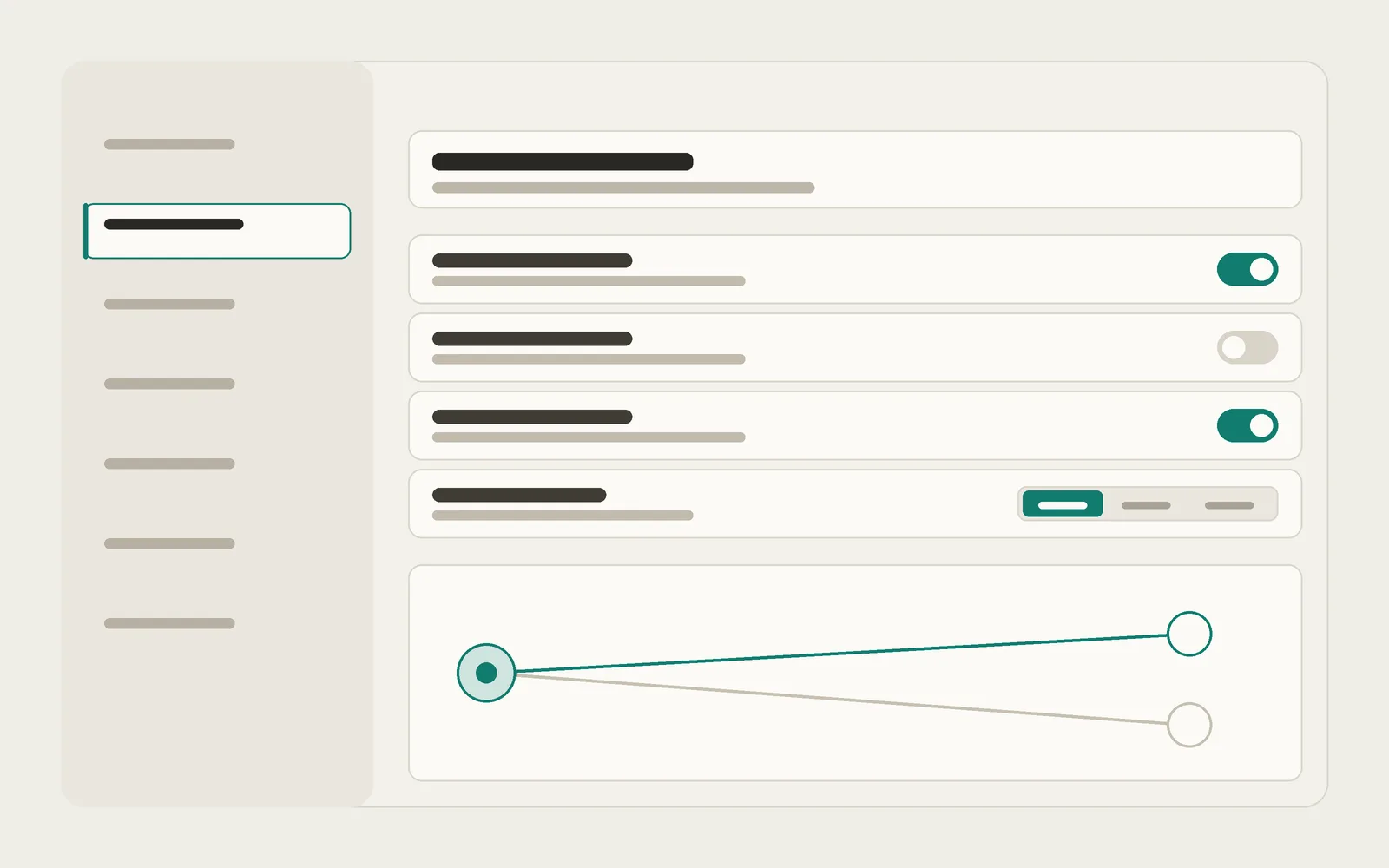
A system settings page: a sticky section rail beside grouped preference rows, each with a label, a description, and a control on the right.
A settings page is how software makes a long list of options feel calm: a left rail to jump between groups, and rows that pair a short label and one line of description with a single control aligned to the right edge. The reusable move is the preference row, a three-part unit you can scan in a second, repeated under quiet group headers. Today each news item is a setting, the primary link is its control, and the routing diagram below shows where Apple now sends a request.
General
Apple Intelligence now runs on models built with Google
Apple unveiled a new Apple Intelligence architecture built on foundation models it co-developed with Google using the technology behind Gemini, running both on-device and through Private Cloud Compute. A new system orchestrator routes each request and tailors the response to the active app, and the upgraded models add image understanding and generation.
Tooling
Core AI becomes the on-device model framework
For developers, Apple is positioning Core AI as the new way to run models on the device, with the Foundation Models API taking image input so an app can do visual tasks without a cloud round-trip. Early developer write-ups describe a shared model interface, so app logic written once can target Apple’s own model or a hosted one by changing a line.
A trillion-parameter model that answers near 1,000 tokens a second
Xiaomi’s MiMo v2.5 Pro UltraSpeed reports output around a thousand tokens per second, the kind of latency that changes how an agent loop feels: planning, tool calls, and revisions return fast enough to stay interactive rather than batch.
Technique
Edit the page, let the agent write the code
Cursor’s Design Mode lets you click an element, draw on the page, or describe a change by voice inside its browser, and the agent turns the gesture into a code edit. It is a tight design-in-the-browser loop: stay on the rendered result and let the diff follow your hand instead of your prompt.
Workflow
Schedule the reps the autopilot is taking from you
A widely shared post argues that the better the autopilot gets, the worse the pilot becomes, because the manual skill quietly erodes until the day you need it. Aviation’s answer is mandatory hand-flying; the practice worth stealing is to book deliberate sessions where you build or debug without the agent, so the muscles it hides stay live.
Recreate this settings page
Paste this into your AI design or build tool to reproduce today’s visual system.
Design a single self-contained HTML page styled as a system settings or
account preferences page, the kind macOS System Settings or a SaaS
account screen uses.

PAGE ARCHETYPE: a settings console. Top app bar with a wordmark and two
nav links. Below it a thin settings bar: a small monospace breadcrumb
and a quiet saved indicator. Then a two-pane layout: a sticky left
section rail and a wide main column.

COMPONENTS: the rail is a vertical list of section links, one marked as
the current section with a filled background, bold weight, and a short
inset edge marker. The main column opens with a settings header: a small
kicker chip, a large headline, a one-line description, and a four-cell
meta strip (issue, date, reading time, section). Under quiet uppercase
group labels, each item is a preference ROW on a card: a bold row title
and one line of description on the left, and a right control column that
is a bordered Open link plus the source domain beneath it. A couple of
rows carry small honest state badges. Include one framed figure, then
full-width panels for a prompt block, a field note, and a numbered
sources list. Panes stack to one column under about 900px.

PALETTE: warm porcelain ground #EFEDE7, sunken panel #EAE7DF, card
surface #FBFAF6, ink #1C1B19, secondary #5F5A51, one flat teal accent
#117C6F for links, the active section, and on-states. No purple-blue
gradient, no neon, no glow, no green-on-black.

TYPE: Schibsted Grotesk for the headline and row titles; Hanken Grotesk
for body and UI; Spline Sans Mono for labels, meta, and source domains;
Newsreader italic for the art-direction line and one pullquote only.

GUARDRAILS: body text at least 18px with about 1.6 line height and WCAG
AA contrast. Cap card radius near 16px, controls near 9px; do not
pill-shape every element. Toggles and the saved indicator are
informational state, marked aria-hidden, never fake buttons, and there
is no fake search field. Use no colored left-border stripe on cards;
distinguish the active rail item with background and weight. Real hover
and focus on links and the rail with ~150ms easing, and disable
transforms under prefers-reduced-motion. No readable text in the figure.

Type: Schibsted Grotesk for the headline, Hanken Grotesk for rows and body, Spline Sans Mono for labels and source domains, Newsreader italic for one editorial line.
Color: warm porcelain ground #EFEDE7, ink #1C1B19, one flat teal accent #117C6F on hairline-divided cream surfaces. No gradients, no glow.
The bottom line
The surface keeps drifting from the system that supplies it: Apple now leases its model brain from Google, agents narrate work in interfaces built to look smart, and the more the autopilot flies the less the pilot can. The job is to keep a hand on what you ship.
“Borrowed intelligence still has to be reviewed by someone who could have built it.”
Field desk, Art Direction Daily
Linked this issue
- Apple Reveals New AI Architecture Built Around Google Gemini Modelsmacrumors.com
- Apple rebuilds Siri on Google AI and Nvidia chips at WWDCthenextweb.com
- Core AI framework documentationdeveloper.apple.com
- On-device AI after WWDC 2026: what changedcallstack.com
- MiMo v2.5 Pro UltraSpeed: a 1T model at 1,000 tokens per secondmimo.xiaomi.com
- Cursor changelog: Design Mode in the browsercursor.com
- The better the autopilot, the worse the pilotjulienreszka.com
- Avoiding skill atrophy in the age of AIaddyo.substack.com
A field experiment from the team behind Beaver Builder AI.