Exploded Office Manual
A drafting-table treatment for software that wants to see the whole desk.
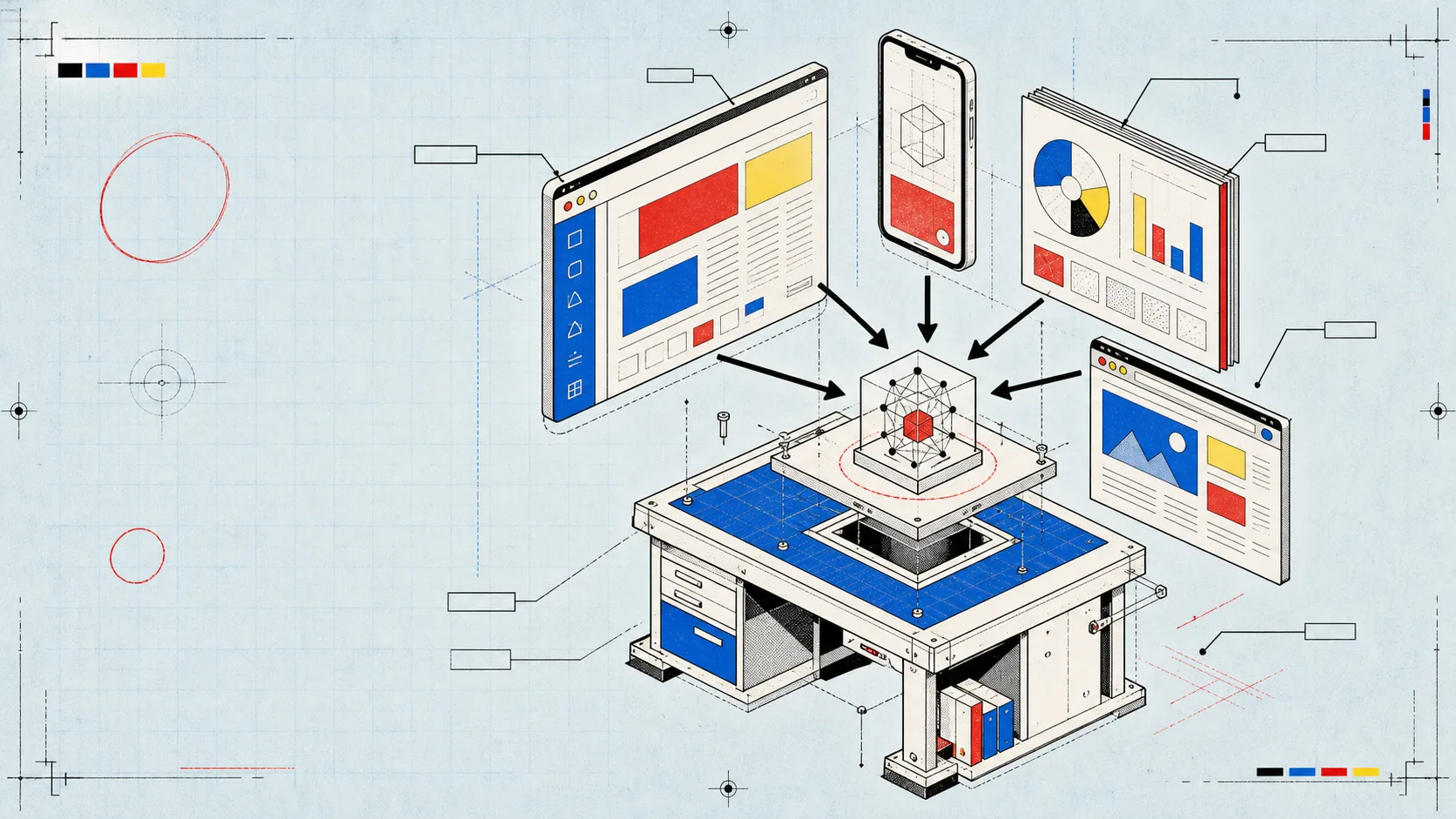
Exploded technical illustration separates an object into visible layers so the reader can understand relationships that are hidden when the machine is assembled. In editorial layouts, the idiom turns context into parts: panes, notes, screens, labels, arrows, and inspection marks. The effect is explanatory without becoming decorative, because every line is meant to show how the work fits together.
Tooling
The working surface becomes input.
Codex learns the frontmost window
The week's cleanest signal came from OpenAI's Codex Mac app: Appshots lets a user press Command-Command to attach the current app window, including a screenshot and extracted text, to an active thread. The detail that matters for designers is not the shortcut. It is the assumption that the agent should inspect the live surface where the work is happening.
That changes the handoff. A web builder can point at a broken layout, a Figma frame, a spreadsheet of content, or a settings panel without translating the whole scene into prompt language first. The prompt becomes less like a ticket and more like a mark on a printout: "this part, with this surrounding evidence."
AI Studio moves the build tab into Android
Google's AI Studio update pushes the same idea onto mobile and native app work. The company says builders can now create native Android apps from the Build tab, preview them in a browser emulator, install them through ADB, and send test builds to Google Play's internal track.
For web teams, the practical lesson is portability. The agentic builder is no longer just a text field beside a web preview. It is becoming a shuttle between mobile, workspace files, deployments, and local development environments, which means design systems need to survive more surfaces than the original canvas.
If an agent can see the work surface, the surface needs to carry better cues: stable labels, visible states, accessible names, and enough surrounding context to make the next action obvious.
Technique
Prompt less like a narrator, more like an inspector.
Ask the agent to read the scene first
When a screenshot or app window enters the thread, the first move should not be "fix it." Ask the agent to name what it sees, identify the likely source of the mismatch, and separate visual evidence from inference. That small delay catches many false repairs because the model has to inventory the surface before it edits the files.
In a page-building workflow, this works especially well for spacing and hierarchy. The agent can compare the rendered view against the intended idiom, then propose a narrow CSS change instead of rewriting the whole section because one panel feels cramped.
Use the app as a witness
The reported Appshots cluster on Digg also shows why UI context beats memory in many agent runs. Users were excited by off-screen text capture because the actual app becomes a witness, not a vague description of what the user remembers seeing.
That matters for design QA. A prompt that includes the rendered page, a failing viewport, and the nearby DOM can ask for a constrained diagnosis: what is visibly wrong, what file likely owns it, and what single edit should be tested first.
The next prompt is not longer. It is better situated.
Workflow
The human still frames the work.
Automation exposes more judgment, not less
Every's new report is useful because it describes the part of agentic work that demos usually skip: after the repeatable layer is automated, humans spend more time framing, reviewing, and deciding what counts as good. In their words, human-agent collaboration is happening inside tools like Codex, Claude Code, and Claude Cowork, where the workspace itself becomes the place work is negotiated.
The pattern matches what designers feel in practice. Agents can generate pages, components, and test runs quickly, but the durable leverage comes from establishing the frame: which audience, which idiom, which constraints, which references, and which tradeoffs are unacceptable.
Agent-era IDEs become coordination rooms
Hacker News surfaced Superset today as a Launch HN item, and its GitHub organization describes the product as a code editor for the AI agents era. The interesting part is the premise: run a group of coding agents locally and make the IDE the coordination room.
That is the workflow worth stealing even if the specific tool changes. Treat each agent run as a visible workstream with a goal, evidence, and review state. The designer or developer is not just waiting for output; they are managing a room full of partial interpretations.
Prompt Lab
Recreate this page.
Paste this into your AI design or build tool to reproduce this issue's visual system.
Design a single self-contained HTML page as an exploded technical office manual, a 1980s drafting-table workbench. The content is a daily design-news briefing: a top nav, an issue masthead with number, date, and read time, a hero headline with a one-line deck, a boxed art-direction note, numbered sections of linked news items with one or two sentences of context each, one pullquote, a monospace prompt block, a sources list, and a colophon.

Treatment: cool drafting paper #EAF3F4 over a faint blue grid; one exploded-view diagram with thin leader lines and numbered yellow figure tags above the fold; section headers as technical manual plates with figure numbers; oxide-red #C43B2F inspection marks as the single accent; engineering blue #1D56A5 secondary; ink #111820.

Type: Barlow Condensed for plate display, Source Sans 3 for body, a monospace for part numbers, figure tags, and metadata.

Guardrails: body text at least 18px with line height 1.6 or more, prose in the body face and never in monospace, line length 60-75 characters, WCAG AA contrast on every surface, hover and focus states on real links, decoration in the margins and panels rather than under running prose, no fake readable text in images, and no default AI styling (no purple-blue gradients, no glow, no pill-shaped everything). Leader lines connect labels to real content, never decorate empty space.
Works in v0, Lovable, Bolt, Figma Make, Beaver Builder AI, or as a Claude / GPT system brief.
Field Note
Context is becoming interface.
The through-line is simple: agents are leaving the isolated chat box and learning to work in rooms. Screenshots, mobile previews, slide decks, IDE panes, and support queues all give the model more of the real surface where judgment happens.
For designers and developers, the opportunity is not to write ever-longer prompts. It is to build clearer rooms: surfaces where state, hierarchy, labels, and intent are legible enough for a human and an agent to share.
Sources
Primary links and signal checks.
- Codex releases Appshots for its Mac app Digg / OpenAI Developers cluster
- Bring any idea to life: Google AI Studio at I/O 2026 Google Blog
- After Automation Every
- Hacker News front page Signal check, May 22, 2026
- Hacker News newest Fresh launch check, May 22, 2026
- Superset GitHub organization Agent-era IDE source